

0% VAT on Solar Ends March 2027
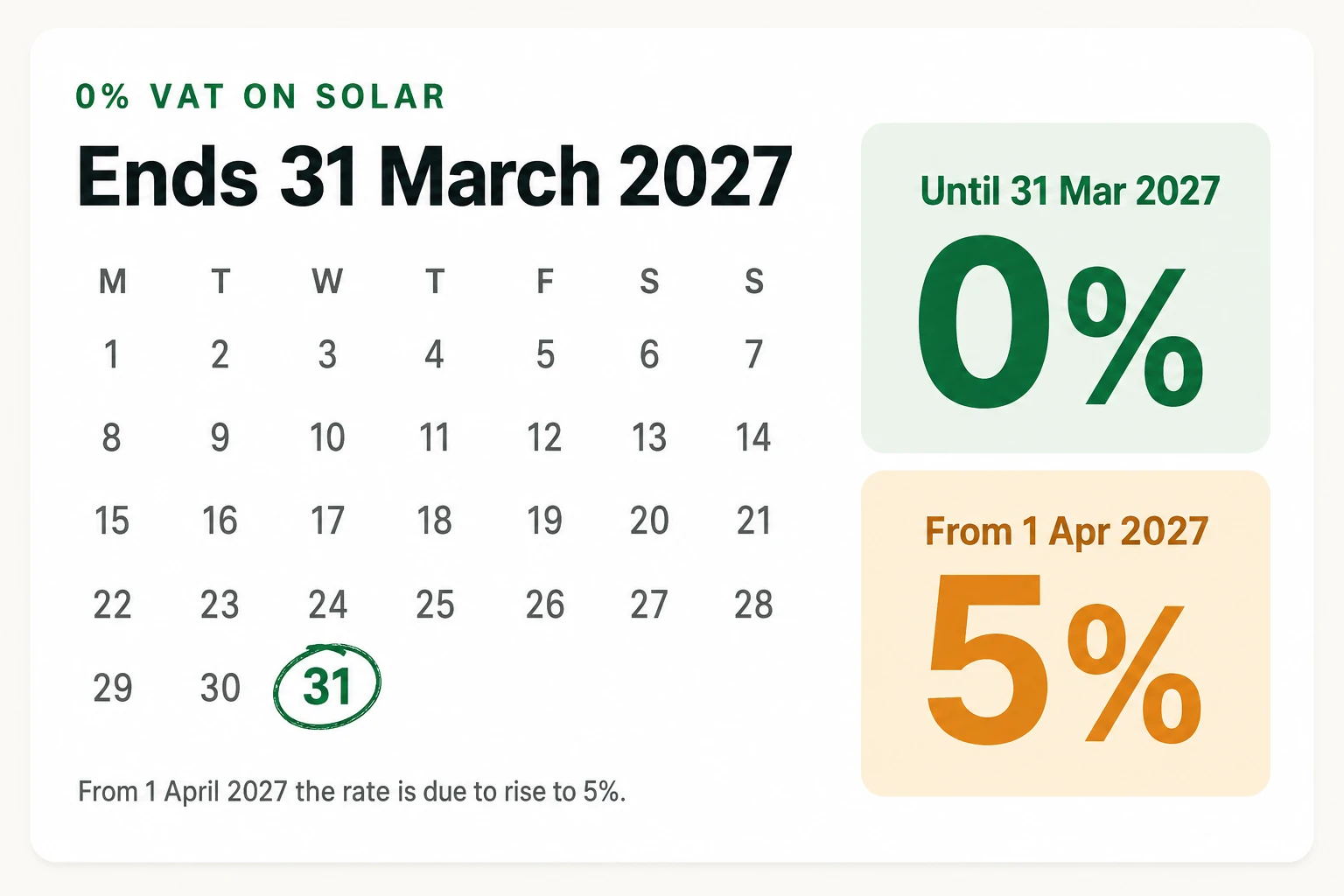
Qualifying residential solar panel and battery installations currently receive 0% VAT until 31 March 2027. This includes standalone battery storage. The rate is scheduled to become 5% from 1 April 2027. Ask your installer to confirm the VAT treatment and relevant tax point for your job.
Key facts
- 0% VAT on qualifying residential solar and battery installations, including standalone batteries, until 31 March 2027
- VAT rises to 5% from 1 April 2027, under gov.uk VAT Notice 708/6
- On a typical £8,000 to £12,000 solar and battery install, 5% VAT works out at roughly £400 to £600 (illustrative range)
What is the 0% VAT deadline on solar?
VAT Notice 708/6 covers qualifying installation of solar panels and electrical storage batteries in residential accommodation. The current 0% rate includes the qualifying installation and supplied materials; buying equipment without installation is not the same transaction.
From 1 April 2027, the rate moves to 5%, the same reduced rate that has applied to this category of work in the past. There is no suggestion from HMRC of it returning to the full 20% standard rate, and no suggestion of the relief being extended again at this stage. The date itself comes directly from gov.uk guidance, not from an installer campaign.
Is this a sales deadline or a real tax change?
It is worth being direct about this: 31 March 2027 is a tax change written into gov.uk guidance, not a countdown sales tactic dressed up to create urgency. We are not going to tell you the sky is falling or that you have to decide this week. If you are planning solar for next year or the year after, this is simply one of the numbers to have in front of you when you work out timing, alongside your roof condition, your finances and your electricity usage.
Plenty of homes will still install perfectly sensibly after April 2027 at 5% VAT. A few percentage points on a project this size is real money, but it is one factor among several, not a reason to rush a decision you have not thought through.
Does standalone battery storage qualify for 0% VAT?
Battery storage can qualify when installed with solar, added to an existing system or installed without solar. Standalone battery installation entered this relief on 1 February 2024.
A battery added later, on its own to an existing solar system, has also been zero-rated since 1 February 2024 under the same notice, so a retrofit battery installed before 31 March 2027 carries no VAT either. Ask whoever quotes the job to confirm the VAT treatment in writing, so it is clear before you commit either way.
In practice, that means the order you do things in matters less for VAT than it once did. A single quote covering panels and battery together is the simplest route, and a battery added afterwards still qualifies for the 0% rate as long as it is installed before the deadline. From 1 April 2027, both routes carry 5%.
Does the VAT rate depend on where in the UK you live?
No. VAT Notice 708/6 is a UK-wide rule set by HMRC, so the 0% rate until 31 March 2027 and the move to 5% after that date apply the same way whether the installation is in Glasgow, Aberdeen, Edinburgh or anywhere else in the UK. There is no separate Scottish VAT rate for solar work, and no regional exemption or extension beyond the one national deadline [F7].
What does vary by area is the practical side of a job, things like roof type, planning rules in conservation areas and the local grid connection process. VAT is the one number on the quote that stays constant regardless of postcode.
Worked example: what 5% VAT means in pounds
For an illustrative installation priced at £8,000 to £12,000 before VAT, a 5% rate would add £400 to £600 if the underlying price stayed the same. Actual quotes depend on the roof, equipment and work required.
That figure is illustrative, based on typical system costs, not a quote for any specific home. Your own number depends on your roof, your panel count and whether a battery is included, which is why a proper survey and written quote matter more than any single figure on a page.
| Before 31 March 2027 | From 1 April 2027 | |
|---|---|---|
| VAT rate | 0% | 5% |
| Extra cost on a typical £8,000 to £12,000 install | No VAT added | Roughly £400 to £600 added |
| Applies to | Qualifying residential solar and battery installations | Qualifying residential solar and battery installations |
Illustrative range only. Your own figure depends on your roof, panel count and whether a battery is included.
What this means for you
If you are already planning solar for the next year or so, the VAT change is one more data point, not a reason to make a rushed call. Getting the system size, roof suitability and finance right will affect your outcome far more than a few hundred pounds of VAT either way.
If your timeline naturally lands before 31 March 2027, you keep the 0% rate. If it lands after, you are looking at 5% on top of the installed price, which is worth building into your budgeting conversation. Either way, ask whoever quotes your job to confirm the VAT treatment in writing, including how any battery is being treated, so there are no surprises on the invoice.
A written quote should always show whether VAT has been applied and at what rate, regardless of which side of the deadline your install falls on. That is a normal, sensible thing to check on any quote, not a sign of urgency, and it means you can compare quotes on a like-for-like basis.
Curious what your own numbers would look like, VAT included? Have a look at current system costs, no obligation either way.
See current solar system costsFrequently asked questions
When does 0% VAT on solar end?
The 0% VAT relief on solar panel and battery installations runs until 31 March 2027. From 1 April 2027, VAT on these installations rises to 5%, under gov.uk VAT Notice 708/6.
Will solar VAT go back up to 20%?
No. From 1 April 2027 the rate moves to 5%, the reduced rate that has historically applied to energy-saving materials, not the standard 20% rate. There is no current indication from HMRC of a move to 20%.
Does the VAT change apply to battery storage as well as panels?
Yes. Qualifying residential battery installation currently receives 0% VAT, whether fitted with solar, added later or installed without solar. The rate is scheduled to become 5% from 1 April 2027. Confirm the treatment of your job in writing.
Should I rush to install solar before the VAT deadline?
Not on VAT alone. The date is a genuine tax change, not a sales deadline, and a few percentage points of VAT is one factor among several, including your roof, your budget and your finance options. It is worth knowing the date, not panicking about it.
How much extra will 5% VAT add to a solar install?
On a typical fully installed solar and battery system priced between £8,000 and £12,000, 5% VAT adds roughly £400 to £600, depending on system size. This is an illustrative range, not a quote, since actual cost depends on your specific roof and system.
Does the VAT deadline apply everywhere in the UK, including Scotland?
Yes. VAT Notice 708/6 is set nationally by HMRC, so the same 0% rate until 31 March 2027 and 5% rate from 1 April 2027 apply across the whole UK, with no separate Scottish rate or regional variation.
Sources
Related guides
Last verified: 8 September 2026. We re-check the facts on this page regularly; if a scheme or rate has changed since, the official source linked above is definitive.